

Project title: Gene Therapy for treatment of rare inherited Arrhythmogenic Cardiomyopathy
Project leaders: Prof. dr. P.A. (Pieter) Doevendans & Prof. dr. E. (Eva) van Rooij
Starting date: May 1st 2023
Project duration: 48 months

Objective and background
The ‘Gene Therapy for treatment of rare inherited Arrhythmogenic Cardiomyopathy (GEREMY)’ project aims to deliver the first cardiac gene therapy (GT) for treatment of rare inherited forms of arrhythmogenic cardiomyopathy (ACM), such as PLN- and PKP2-mutation induced ACM. These will serve as models for other inherited heart diseases and contribute directly to the portfolio of treatments for rare cardiac diseases.
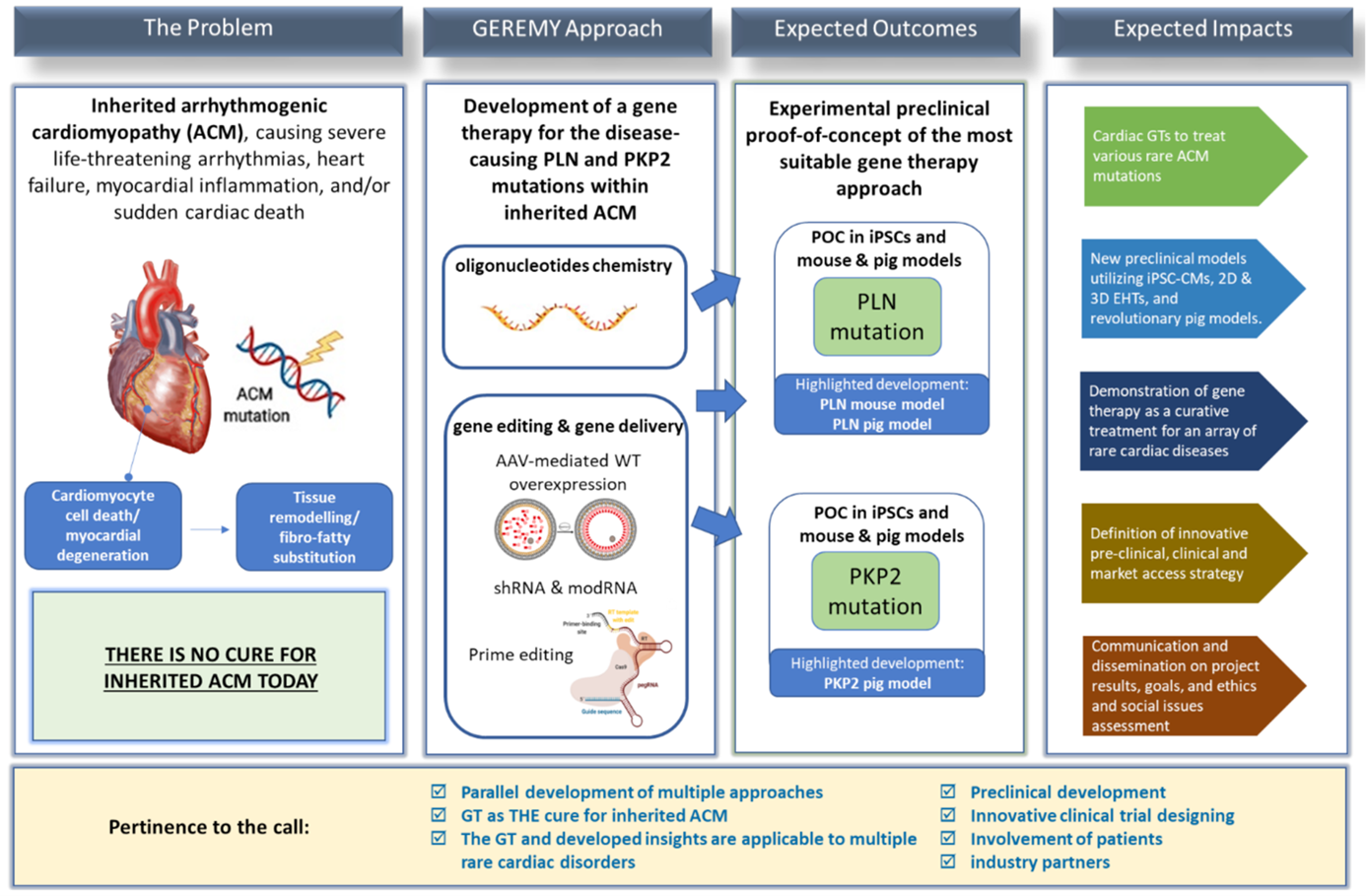
Inherited cardiovascular conditions are a group of genetic disorders that primarily affect the heart. They include conditions such as cardiomyopathy, inherited electrical conditions called channelopathies and problems with the main blood vessel carrying blood from the heart, the aorta. They affect people of any age. If left untreated, some inherited heart conditions can be life-threatening. These inherited cardiac disorders cover a wide variety of relatively rare cardiac diseases, for which we don’t have any effective treatment or cure available. The GEREMY project would like to change that, and thus is THE approach to develop therapies for many (rare) inherited cardiac disorders including dilated and arrhythmogenic cardiomyopathy.
Approach
The GEREMY consortium collaborates in a multidisciplinary matter to achieve its ambitious aim to develop the first cardiac gene therapy for treatment of rare inherited arrhythmogenic cardiomyopathy by accomplishing the deliverables and milestones within the different Work Packages (WPs).
WP1 | Engineering of human in vitro disease models for proper assessment of therapeutic interventions |
WP2 | Parallel development of GT approaches for PKP2- related cardiomyopathy |
WP3 | Parallel development of GT approaches for PLN- related cardiomyopathy |
WP4 | In vivo validation of GT candidates in novel translational large animal model |
WP5 | Ethical and social embedding of GT implementation |
WP6 | Preparation for clinical trials and other regulatory aspects |
WP7 | Communication, dissemination, and exploitation |
WP8 | Project management |
Key words: Gene therapy, cell therapy, regenerative medicine, pharmacology, pharmacogenomics, drug discovery and design, drug therapy, rare diseases, cardiomyopathies, PLN, PKP2, oligonucleotide chemistries, gene editing and gene delivery, patient engagement.
This project is coordinated by the Netherlands Heart Institute and being conducted by a consortium of 10 international partners:
The Netherlands Heart Institute (NLHI) is an institute that creates optimal circumstances for cardiovascular research by providing project coordination and infrastructure that is best organized centrally, proactive and project transcendent.
Representative: Pieter Doevendans
The Hubrecht Institute is a research institute of the Royal Netherlands Academy of Arts and Sciences (KNAW). Research at the Hubrecht Institute is pioneering in developmental and stem cell biology. The institute encompasses 20 research groups that perform fundamental, multidisciplinary research on healthy and diseased cells, tissues and organisms.
Representative: Eva van Rooij
Representative: Peter van der Meer
The Technical University Munich Medicine and Health (TUM-MED) links the study of medicine with the natural sciences, life sciences, engineering and informatics. This generates enormous potential in the fields of biomedical engineering and digital medicine, enabling us to meet the needs of a modern healthcare system with preventive strategies and the latest technological resources. TUM-MED develops new imaging technologies to gain more detailed insights into the human body and investigate new approaches for personalized diagnoses and therapies.
Representative: Christian Kupatt-Jeremias
The University of Eastern Finland (UEF) responds to global challenges through a high standard of interdisciplinary research and education. In doing so, they build a responsible and sustainable future. The strategic research is focused on four profile areas: Ageing, lifestyles and health (1), Environmental change and sustainable use of natural resources (2), Cultural encounters, mobilities and borders (3), and Diversifying learning and interaction (4).
Representative: Seppo Yla-Herttuala
The European Patients’ Academy on Therapeutic Innovation (EUPATI) is a multi-stakeholder public-private partnership. It is a successful programme that provides education and training to increase the capacity and capability of patients and patient representatives to understand and meaningfully contribute to medicines research and development (R&D), and to improve the availability of medical information for patients and other stakeholders.
Representative: Maria Dutarte
The PLN Heart Foundation’s (Stichting PLN) mission is to find an affordable treatment for the genetic heart muscle disease PLN. As a foundation, they fund scientific research and bring scientists together. Additionally, the PLN Heart foundation aims to connect individuals with PLN, raise awareness about PLN, and provide support to affected families.
Representative member: Pieter Glijnis
The Catholic University of Leuven (KU Leuven) is an international community where innovative research forms the basis of all our academic programmes. Across the university, driven researchers and curious students continually gain new insights and use their knowledge to tackle the foremost challenges of our time.
Representative: Pascal Borry
Kapadi (former OncoBay, Clinscience and Exom) offers comprehensive and custom curated solutions to biotech companies ready to move their immuno-oncology assets from concept to clinic. The industry leading global oncology Contract Research Organization (CRO) supporting biotech partners to accelerate innovative research. Kapadi delivers specialized biotech CRO-services, expertly navigating the intricacies of early-stage drug development. They harness state-of-the-art technology solutions and advanced data visualization to propel operational and data excellence.
Representative: Lisa Zimmerman
Representative member: Mauro Giacca
ARVC-Selbsthilfe is a German patient association supporting individuals with Arrhythmogenic Right Ventricular Cardiomyopathy (ARVC) and their families. It provides peer
support, educational resources, and raises awareness about the condition. The organization works to improve ARVC knowledge, support research, and advocate for better access to diagnosis, effective treatments, and high-quality care for ARVC patients.
Representative member: Ruth Biller
Follow us on LinkedIn to stay updated about the project
Linked-in link: https://www.linkedin.com/showcase/geremy-eu